 Contact Us
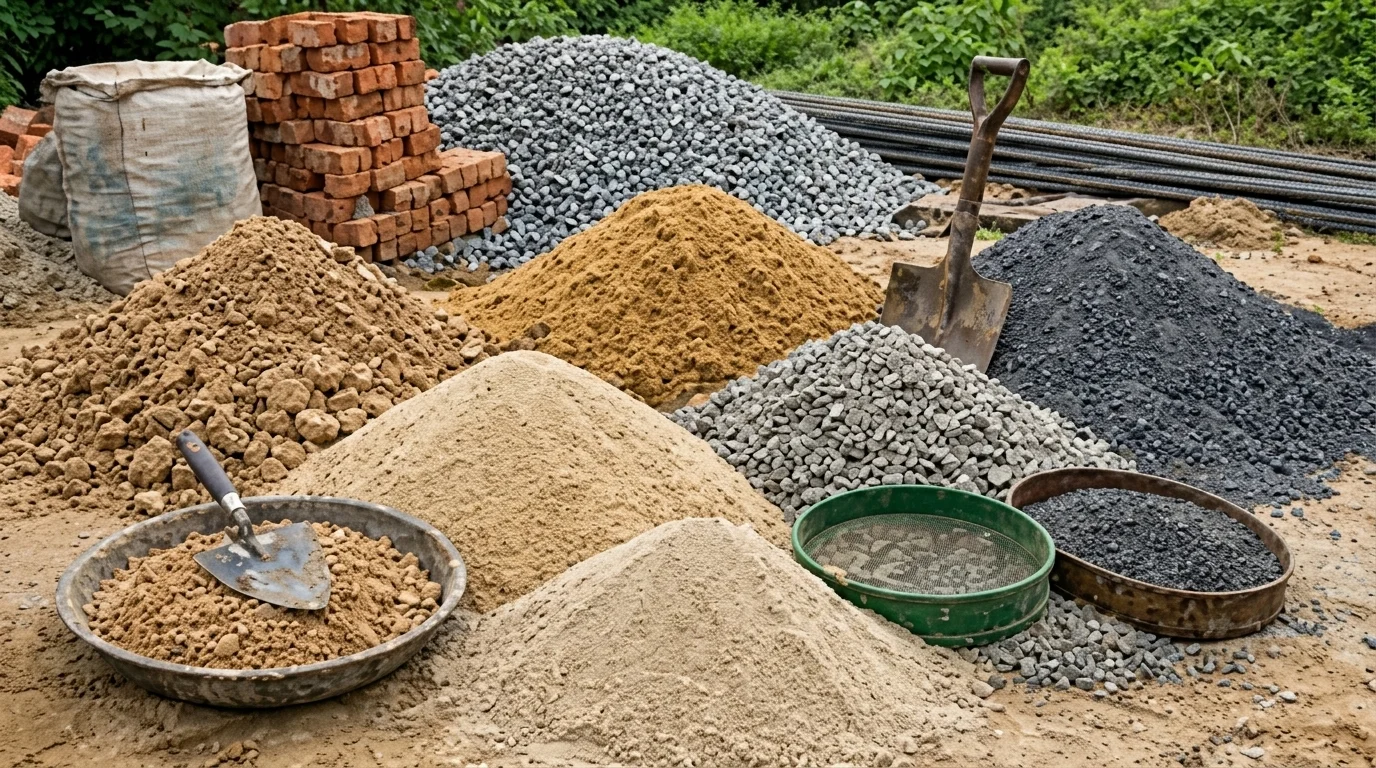
Have you ever thought of why concrete mixes with the same cement can have different results? The reason behind this may be found in one of the simplest building materials: sand.
Sand forms a considerable amount of concrete, mortar, and plaster, but the quality, size, grading, moisture content, and purity of sand may differ greatly. Inappropriate choice of sand may cause difficulties with workability, bonding, surface flaws, cracking, and lack of durability. The suitable sand is determined by the place and purpose of its application.
This guide will tell you how to choose proper sand for concrete, brickwork, and plastering. Here you will find information about different kinds of construction sand and their properties.
Related:https://gharhub.com/today-sand-price-in-pakistan
What Is Construction Sand and Why Does It Matter?
Construction sand is a naturally occurring or manmade granular material that is combined with cement, water, and other materials to form concrete, mortar, plaster, and other construction products.
Sand is more than just filler in the mixture. It makes up a large percentage of the mixture and influences its behavior. For instance, concrete requires sand that is compatible with cement and aggregate. Plaster requires sand that produces a smooth surface, while mortar requires sand that facilitates bonding between bricks or blocks.
Good quality sand should be:
Clean and free from harmful impurities
Properly graded
Suitable for the intended construction work
Strong enough to resist weather and load
Free from excessive silt and clay
Consistent in size and quality
So, the best sand depends on the job.
How the Wrong Sand Affects Strength, Durability, and Finish
Choosing poor-quality sand can create problems that are not always visible on the first day.
The table below shows some common sand-related problems and how they can affect construction quality:
Sand Problem | Effect on Strength | Effect on Durability | Effect on Finish |
Poor particle grading | Can create more voids and affect concrete or mortar density | May allow a less dense mixture that is more vulnerable to moisture penetration | Can produce an uneven or inconsistent surface |
Excess silt or clay | Can reduce the quality of the bond between cement paste and aggregate | May contribute to poor long-term performance | Can make plaster difficult to finish and may contribute to surface defects |
Excess moisture | Can change the actual water content of the mix if not accounted for | Incorrect water content can affect hardened concrete performance | May change consistency and make finishing less predictable |
Harmful salts | Can affect concrete performance, especially when reinforcement is present | Chlorides can increase the risk of reinforcement corrosion | May contribute to staining or surface problems |
Excessively fine sand | Can increase water demand and affect mix proportions | Higher water demand can affect long-term performance if the mix is not adjusted | May increase shrinkage and contribute to cracking |
Excessively coarse sand | Can reduce workability and affect mortar consistency | Poorly compacted or poorly finished material may have durability concerns | Can produce a rough or uneven plaster finish |
This is why sand should be selected according to its purpose rather than appearance alone.
Types of Sand Used in Construction
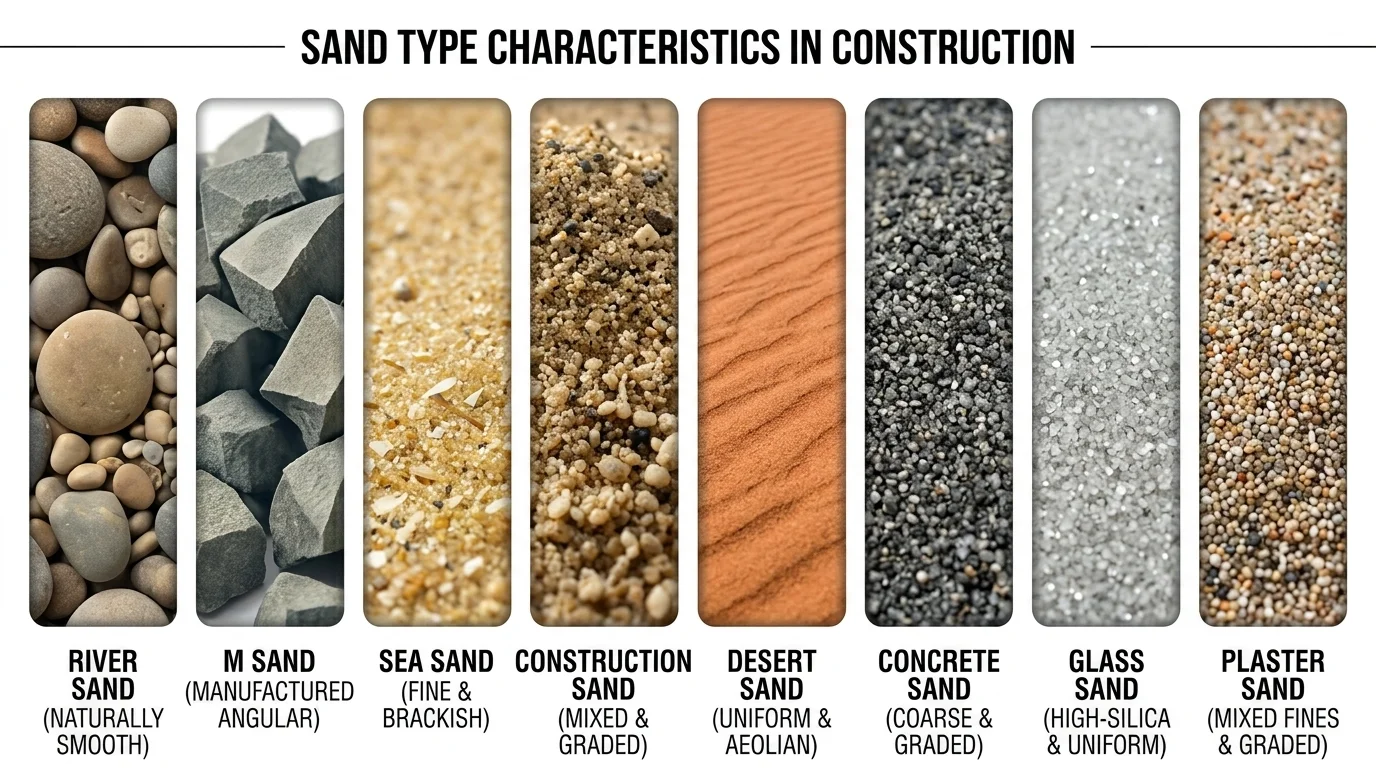
Different types of sand are available for construction. Their properties can vary based on where they come from and how they are processed.
River Sand
River sand is naturally found in rivers and streams. It is usually used in concrete, mortar, and other forms of construction work, provided it is of acceptable quality.
River sand may have varying quality. It must be tested to check whether it contains silt, clay, organic matter, and other impurities. Its particles tend to be rounded.
Common uses include:
Concrete
Brickwork
Masonry mortar
General construction
Manufactured Sand (M Sand)
Manufactured sand, commonly called M Sand, is produced by crushing and processing suitable rock.
Unlike naturally occurring sand, its particle shape and grading can be controlled during production. M Sand can provide a consistent material when it is properly manufactured and screened.
Common uses include:
Concrete
Mortar
Masonry
Some plastering applications
Pit Sand
Pit sand is extracted from deposits that occur beneath the surface. Pit sand can be made up of angular and abrasive grains. The characteristics of pit sand are very much dependent on its geographical origin. Prior to the use of pit sand, it must be checked for the presence of high levels of clay and silt.
Plastering Sand (P Sand)
Plastering sand is selected for applications where a workable mixture and suitable surface finish are required.
It is usually finer than sand used in some concrete applications. The grading should always be according to the plaster requirements. Fine sand is not necessarily better. In plastering, what is needed is proper grading and cleanliness, not necessarily fine sand.
Sea Sand
Sea sand comes from marine environments. It can contain salts and other materials that make it unsuitable for many reinforced concrete applications if it has not been properly treated and tested.
Why It's Usually Avoided
Chloride salts are a major concern because they can contribute to corrosion of steel reinforcement. This is especially important in reinforced concrete structures.
For this reason, untreated sea sand should not be selected simply because it is cheap or easily available. Any marine sand considered for construction should meet the relevant quality requirements and be properly tested.
Related: https://gharhub.com/latest-sarya-rates-in-pakistan-2026
Fill Sand and Utility Sand
Fill sand is generally used where the main purpose is filling or leveling rather than producing high-quality concrete or plaster.
Common uses include:
Filling low areas
Leveling
Backfilling
Certain utility applications
How to Choose the Right Sand for Concrete, Brickwork, and Plaster
There is no single "best sand" for every construction task. The right choice depends on the application.
Sand Type | Best suited for | Advantages | Limitations |
River sand | Concrete, mortar, general construction | Natural and widely used | Quality can vary |
M Sand | Concrete and mortar | Controlled production and consistent grading possible | Quality depends on processing |
Pit sand | Selected construction applications | Can have suitable angular particles | May contain clay or impurities |
Plastering sand | Plastering | Suitable for surface finishing | Must meet required grading |
Sea sand | Limited applications | Easily available in coastal areas | Salts can create durability concerns |
Fill sand | Filling and leveling | Useful for bulk filling | Not a substitute for structural sand |
Key Properties to Check Before Buying Sand
The name of the sand alone does not tell you whether it is suitable. Two sands with the same name can have different properties.
People Also Search For: https://gharhub.com/updated-construction-materials-pricelist
Check these key factors before buying:
Particle Size and Grading Zones
Particle size describes how large or small the sand particles are. Grading describes the distribution of different particle sizes within the sand.
A well-graded sand contains a useful range of particle sizes. This allows particles to pack together more efficiently.
Fineness Modulus
The fineness modulus, or FM, is an index used to describe the average fineness of aggregate particles.
A higher FM generally indicates coarser sand, while a lower FM indicates finer sand. Two sands can have a similar FM but different particle size distributions.
Silt and Clay Content
Too much silt or clay can interfere with the bond between cement paste and sand particles. It can also increase water demand and affect the performance of concrete. A visible layer of very fine material above the sand can indicate excessive silt or clay.
Moisture Content and Bulking of Sand
Sand can hold water between its particles. Interestingly, damp sand can occupy more volume than completely dry sand. This effect is known as bulking of sand.
If the moisture condition changes, the volume measured at the site may not represent the same amount of dry sand.
Particle Shape and Texture
Particle shape affects how sand behaves in a mixture. Rounded particles can improve workability, while angular particles can provide greater interlocking. Manufactured sand often contains more angular particles because it is produced by crushing rock.
Harmful Impurities: Salts, Organic Matter, and Mica
Sand can contain unwanted materials such as:
Chloride salts
Sulphates
Organic matter
Excess clay
Silt
Mica
These impurities can affect concrete, mortar, or plaster performance. Organic matter can interfere with cement hydration. Salts can create durability concerns, particularly around reinforcement.
Selecting the Best Sand for Concrete
Concrete contains cement, water, fine aggregate, and coarse aggregate. Sand normally acts as the fine aggregate. The goal is to select sand that provides suitable grading, cleanliness, and workability.
Ideal Grading and Particle Size for Concrete
Concrete sand should have a suitable range of particle sizes.
A well-graded fine aggregate helps fill spaces between coarse aggregate particles. This can help create a dense concrete mixture. For structural concrete, visual inspection should not replace proper aggregate testing.
Common Mistakes When Choosing Concrete Sand
Avoid these common mistakes:
Choosing sand only because it looks clean.
Using untested sand for structural concrete.
Ignoring silt and clay content.
Assuming all river sand has the same quality.
Assuming all M Sand is suitable for every application.
Ignoring moisture when measuring sand by volume.
Choosing the cheapest sand without checking its properties.
Choosing the Best Sand for Brickwork and Masonry Mortar
Brickwork needs mortar that can spread easily and create a good bond between masonry units. Sand forms a major part of this mortar.
Recommended Sand Type and Texture
For brickwork and masonry mortar, use clean, well-graded sand that meets the relevant specification.
The sand should be workable without containing excessive clay or other harmful impurities. Very coarse sand can make mortar difficult to spread. Excessively fine sand can increase water and cement demand.
How Sand Affects Mortar Bond and Workability
Sand affects how mortar moves around bricks and fills joints.
A suitable particle distribution can help the mortar spread evenly. If the sand contains too many fines, the mortar may require more water. If it is too coarse, the mortar may feel harsh and difficult to work with.
Picking the Best Sand for Plastering
Plastering requires special attention because the final surface is visible. The sand must help produce a workable mixture and a suitable finish.
Why Fine, Well-Graded Sand Matters for a Smooth Finish
Plastering sand should be clean and properly graded.
Proper grading helps the plaster spread across the wall and create a consistent texture. If sand is excessively fine, the mixture can require more water and cement paste. This can increase shrinkage and affect performance.
How the Right Sand Helps Prevent Plaster Cracks
Sand selection is only one part of crack prevention.
Cracks can also result from:
Excess water
Poor mix proportions
Excessively rich cement mixes
Poor curing
Movement in the wall
Improper surface preparation
Excessively thick plaster
Unsuitable sand grading
Properly selected sand supports a stable plaster mixture, but good application and curing matter just as much.
Key Takeaway
Sand selection is one of the crucial factors in proper construction. The best sand is neither the finest, whitest, nor cheapest sand available. It is the sand which suits the particular construction and meets all the required quality parameters.
For concrete, special care should be taken for grading, cleanliness, shape of particles, and contamination.
For brickwork, select the sand which gives proper mortar with good binding capacity.
For plastering, use clean and properly graded sand which gives a good finish.
Before purchasing, check the particle size, grading, silt and clay contents, moisture content, and harmful impurities. For structural construction, proper testing and project requirements should be considered rather than appearance.
Frequently Asked Questions
What is the best sand for concrete?
The best sand for concrete is graded sand, which is in line with the construction specification standards. Both river sand and M Sand may be used provided they meet the specifications.
Is it possible to use the same sand for plastering and brickwork?
Not always. Sand meant for brickwork is not necessarily appropriate for plastering because the sand should have grading suitable for achieving the desired finish for plastering.
Which one is better: Manufactured Sand or River Sand?
Manufactured Sand may offer a consistent grading. Similarly, river sand may also prove to be appropriate. It all depends on the quality and grading of the sand.
Why should sea sand never be utilized in building?
Untreated sea sand could include chloride salts, which might cause some durability problems and might help in the corrosion of reinforcement bars in reinforced concrete. Marine sand can only be used when it fulfills all requirements.
How to know if my sand has silt?
A test can be done through a jar test initially. Put sand with water in a transparent bottle, agitate it and allow it to get settled. If there is a large quantity of fine material found on top of the sand, then it has high silt or clay content. Testing is better in the laboratory.
Is it true that finer sand produces stronger concrete?
Not always; too finely ground sand increases the water requirement.
What is the difference between sand and aggregate?
Fine aggregate can be said to be made up of sand, whereas aggregates like gravel or crushed stone make up coarse aggregates. They can both be added to concrete together to give good particle sizes.
Is it necessary to wash the sand before use?
Cleaning can be useful in getting rid of some unwanted substances such as fine materials or clay, among others, but then again, whether the sand needs washing or not depends.